Often we do get a little muddled on our framing assessments for any innovation activity we are considering, and we then often don’t ask the appropriate questions at the right time.
I think there is a neat four-box approach to this which hopefully you might see has value to your rating and judgements of the innovation opportunity. The four framing criteria
Formulation Principles
Formulation Risks
Execution Principles
Execution Risks
So the need is to ask critical questions in given boxes of enquiry.
Shellfish poisoning, have you ever suffered from it? There is rule that when there is not a “R” in the month you should be more careful on eating clams, oysters, mussels or scallops. Today with more commercial harvesting that risk or rule has been greatly reduced.
I gather in the months of May, June, July and August- the northern hemospheres (usually) warmer months- there is higher potential where algal blooms and also in European climate, some shellfish are less palatable as oysters, for example, are spawning at this time. This raises the risk that can spread toxins and lead to a possible poisoning.
Now you might be wondering what this has got to do with innovation? Well, I’m off to Singapore for ten days in early May and I certainly will be ‘hitting’ the shellfish buffet but really innovation is top of my agenda for this visit and one thing that I will remind people about is to focus on the “R” in innovation.
What do I mean by focusing on the “R” in innovation?
Some time back I compiled a list of those critical areas that I felt need addressing for innovation to have a chance of success. Going through them again today and in light of different insights picked up on the way, I added more of a descriptor to each.
I certainly think these reflect the struggles within innovation that need working upon constantly, so it has a better chance to succeed.
This revised thinking I feel has upgraded my own focal points as areas I will be exploring even further in my work in the period ahead.
What do you think? Do you think the list is missing something?
I’m sure we have all come across the Rubik Cube, a 3-D mechanical puzzle, invented in 1974 by Erno Rubik as one of the world’s best-selling toys.
The classic cube has six faces covered by nine stickers each offering a solid colour (white, red, blue, orange, green and yellow). The cube has a pivot mechanism enabling each face to turn independently, thus mixing up the colours.
For the puzzle to be solved you must achieve that each face is to be made up of one consistent colour. It was suggested the cube was originally built to aid students to understand 3D objects but actually Rubik’s actual purpose was solving the structural problems of the parts moving independently without the entire mechanism falling apart.
Innovation is equally a puzzle with moveable parts
When you have some sun on your back after a long period of those winter months, you just always begin to feel life is so much better going forward.
Life seems to reawaken within. I often wish we could capture the ‘sense’ of spring and what it promises to bring from this change of season. Those of us who witness the change of seasons are so lucky.
I’ve also been reminded recently about the phrase offered by a number of leaders to explain a positive encouraging shift after a tough time, it goes like this: “we do see some green shoots that are offering some early signs of growth and recovery.”
Spring captures that growth moment. It is often talking to us of renewal. Innovation needs that capturing opportunity as well.
I’ve been reading a fair amount recently about the “lack” of innovation leadership within organizations. Where there is smoke there has to be fire I suspect, but does it need to be so?
Internal leadership of innovation suffers from exactly the same critical problem that the people working on innovation suffer from, of a lack of timeand opportunity to study alternatives, as all are caught up in ‘driving’ their innovation through their internal system.
This “alternative voice” is often missing and this can so easily come through external advocacy. This is unlikely to come from the innovation consultant brought in to undertake ongoing work as that is very different, this is more critical, more specialized, even strategical supporting role, involving peer-to-peer engagement.
This peer-to-peer helps explore those critical issues relevant to you and where your organization is. Its aim is to offer a different perspective, so as to alter opinions or build new insights, that often cannot be evaluated without considerable deflection from the daily managing innovation that is taking place in often complex and challenging situations.
Yet alternatives need to be considered so knowledge can evolve.
I have recently been in some different discussions about the merits and balances required for the separation to manage incremental and radical innovation. Partly this is in preparation for a workshop later this month but partly from a conversation, I am having with a sizable, well-respected organization, with its head office based here in Europe.
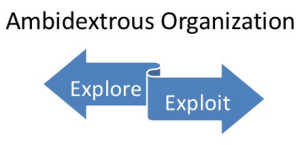
In the conversation within the organization, we were discussing the breakdown in their treatment of incremental and radical and they suggested this was being managed within an “ambidextrous structure” yet I was not convinced. I have to point out this was only a part of a broader story on the difficulties of managing conflicting innovation demands that they were having.
One key constraint in their thinking I felt was not having distinct units as they were trying to manage incremental and radical through the same process and that, for me, is a basic mistake.
We have been entering some perilous times recently and I can’t imagine when Joseph Schumpeter outlined his groundbreaking efforts for explaining “creative destruction” he or anyone else, could imagine this being flipped around to what we are facing more today, in a more innovative era, that of “destructive creation”.
Schumpeter saw “creative destruction” as the renewing, through new innovation, society’s dynamics that would lead to higher levels of economic development and welfare.
At the same time recognizing that this destroyed a few of the incumbents to the benefit of many more newcomers and increasing value creation for broader society.
Today it seems we are caught in the reverse of this- the process of “destructive creation”- where it benefits a few rather than the many. This sets out often to destroy or greatly diminish the usage value of existing products and services before it is optimal to actually do so, and in the process incurring often significant costs not taken into account at the time.
These unforeseen issues have consequences that negatively affect parts of society not foreseen or contemplated at the time.
“Slow constrains quick, slow controls quick” There is so much built in tension, bias, barriers, mindsets, mental model conflicts, and all types of friction seemingly going on around us, you must sometimes think all our organizations can only be totally dysfunctional.
The Scream by Edvard Munch for Dysfunctional Organizations
Has anyone not come across some or all of these?
Dysfunctional leadership symptoms and those typical warning signs of dictatorial leadership, no feedback on performance, personal agendas, more ‘political’ compensation than ‘performance related ones, inefficient use of resources, empire-building practices, unequal workload distribution, too much management, fragmented organization efforts.
There is simply just too much talk, ineffective and incessant meetings, a lack of collaboration across departments, ‘selective’ low productivity when you are working way beyond the normal, feeling in a constant crisis mode, watching a morale deterioration take place before your eyes, the backstabbing, starving projects of essential resources and finally, working in highly stressful workplaces.
A pretty depressing list isn’t it? I’m sure you can think of a few more besides.
Making innovation a constant daily task for everyone in finding time and space to become involved in, is certainly a real problem for many organizations.
Innovation does not sit comfortably alongside efficiency or effectiveness as it requires a much looser structure. It constantly ‘flies’ in direct conflict too much for many within organizations to create resistance and adoption.
Innovation is looking to increase variability, nearly everything else in the organization is the exact opposite. How do we address this resistance and make innovation part of the daily working routines?
Where can we start? We have to open up our thinking to a number of “possible paths” to allow it to flow. I believe innovation should not be highly structured; it should be more loosely structured to allow the possibility.
For a start individuals and organizations needs to explore multiple ways to learn and find the right pathway for innovative learning as they progress.
This needs a more ‘dynamic social fabric’ to allow it to flow, it needs organizational encouragement. It needs mutual adaption and mutual adjustment. The understanding of the absorptive capacity framework I’ve outlined before helps structure this.