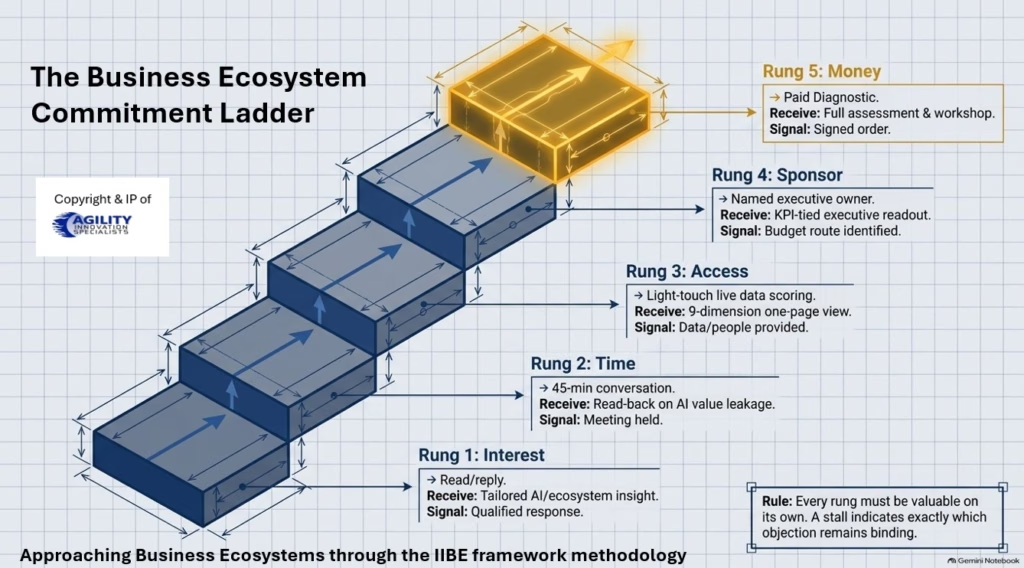
The Business Ecosystem Commitment Ladder

The ladder of commitments to Business Ecosystems

Today, we are increasingly recognising that modern business does not behave like those linear systems we designed in the past years.

The need for business ecosystems cannot evolve through sequential design, not can they fully be understood through decomposition into isolated parts. Their behaviour emerges through interaction, adaptation , and continuous reconfiguration across multiple structural dimensions.

We have to learn these, we have to adapt and that growing recognition that conventional analytical and management approaches were not designed for this complexity.

Do you feel that growing tension?

Tension: You have evidence of interest without commitment and you have the barrier in reluctance to change. Pricing isn’t the obstacle yet.

Cause: That real reluctance to change the business model as you can’t afford disruption at this time and you have no capacity to undertake such a shift. Yet markets are rapidly changing

Outcome: Business Ecosystems are not today’s priority and most probably in many executives view AI alone will fix this. It will not!

The IIBE was developed in response to this gap- not simply as another framework but as a discipline for working with ecosystem complexity in its natural form.

There are some real responses here. Staged commitment can resolve these.

Read more

Can’t You See What’s Changing? Its Time for Winning as an Ecosystem.

https://www.amle.org/collaboration-the-missing-standard/

Executive Briefing: Across every global sector, enterprise executive teams are experiencing a subtle, unsettling phenomenon. Deals that should be straightforward wins are slipping away.

Established market leaders—holding superior technology, deeper balance sheets, and decades of domain authority—are routinely losing ground to rivals whose individual capabilities are demonstrably weaker.

This is not an execution failure, a pricing misstep, or a marketing deficit. It is the signature of a fundamental market shift: the unit of competition has changed. Competition is no longer an arena of isolated firm against isolated firm.

It has become a contest of collaborators within one ecosystem architecture against ecosystem architecture in another

This paper serves as a strategic mirror for enterprise leadership, dissecting why single-entity strength has become a vulnerability and detailing how the Intelligent Integrated Business Ecosystem (IIBE) transforms organizations into invincible collaboration hubs.

Read more

Why Industrial Growth Logic Fails for Business Ecosystems, It Ruptures

Executive Briefing: For over half a century, executive management education, management consulting, and capital allocation models have been organized around a single imperative: scale.

When enterprise leaders encounter a promising innovation, a strategic partnership, or a digital initiative, the immediate directive is uniform: “Optimize it, standardize it, and scale it.”

While this logic generated unprecedented wealth in 20th-century manufacturing and linear software delivery, it has become one of the most destructive forces in modern business strategy. Modern value creation has crossed a structural threshold.

When applied to multi-actor networks, legacy scale logic produces friction, erodes partner trust, and stalls transformation. This paper exposes the hidden flaws of industrial scale logic and outlines the compounding framework of the Intelligent Integrated Business Ecosystem (IIBE).

Read more

Building the Structural Blueprint of Ecosystem Architecture

The Need for a Unified Ecosystem Architecture- how value is created

Executive Briefing: Modern enterprise value creation has crossed an irreversible threshold. The defining industrial and technological challenges of our era—decarbonisation, connected care, resilient multi-tier supply chains, and cross-domain AI—cannot be solved within the legal or operational boundaries of a single firm.

Yet, enterprise leadership teams continue to deploy 20th-century linear management tools, gatekeeping platforms, and bilateral vendor contracts to govern multi-actor networks.

The resulting friction is not an execution failure; it is an architectural failure. This paper establishes the structural blueprint for the Intelligent Integrated Business Ecosystem (IIBE)—the missing layer that transforms fragmented partner networks into continuous, compounding intelligence engines.

Read more