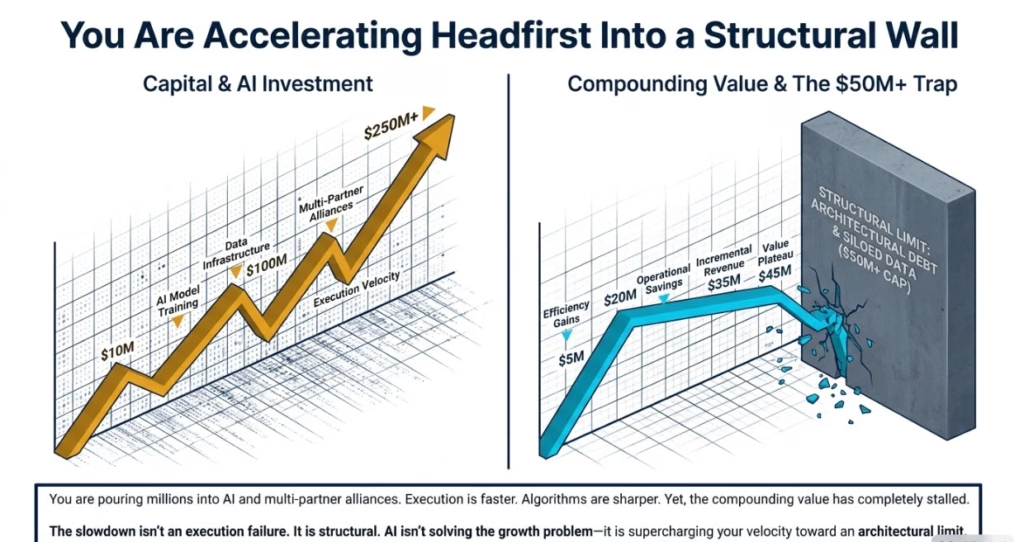
The Tension: Enterprise leaders routinely ask: “We built the digital platform, secured major industry partnerships, and connected our data flows—so why isn’t alliance value compounding as expected?”
The Cause: Organisations fall into The $50M+ Ecosystem Trap by applying traditional platform control, gatekeeping, and static calendar-based governance to complex, multi-partner networks.
The Outcome: Transitioning from rigid coordination to dynamic orchestration allows independent actors to generate emergent value that no single central manager could direct alone.
The Four Invisible Ceilings faced and why Enterprises Scaling Stalls
1. Executive Briefing
The Tension: Major enterprise organisations are pouring unprecedented capital into digital platforms, AI sensing, and partner ecosystems, yet execution speed isn’t yielding growth. Instead of compounding value, initiatives hit performance ceilings that traditional management tools cannot diagnose.
The Cause: Scaling beyond organisational boundaries using legacy corporate architecture forces multi-partner networks into four invisible ceilings: The Velocity Illusion, The Intelligence Plateau, Governance Inertia, and Capital Erosion.
The Outcome: Unlocking compounding network value requires moving away from linear platform management toward a dedicated ecosystem architecture that bridges dynamic orchestration and adaptive governance.
It is never easy to shift and adjust to new versions of any architectural framework. In the case of the Intelligent Integrated Business Ecosystems (IIBE) approach, I felt I was getting towards a pressure point to recast part of the IIBE, specifically its intelligent engine. Let me briefly explain.
My aim here is to sharpen the IIBE’s Intelligent Engine — not rebuilding It but provide a further disciplined refinement to the IIBE’s Intelligent Engine, so it becomes sharper, not bigger
I had conceived this part of the IIBE around Form- Flow- Fusion in V2 and it was where Human and AI combined. Today that world has accelerated, fragmented, and multiplied. The environment around Ecosystems has changed.
The 60-Second Plain English Pitchfirst
Most companies try to run increasingly complex business partnerships using a 1990s mindset: a fixed master plan, a central coordinator, and slow, manual decision-making struggle and lose so much value and opportunities to grow their businesses.
The IIBE V3 refinement sharpens how the Blueprint reads and routes signal — it does not hand decision-making to the system.
It builds a setup where human judgment, AI sensing, and ecosystem signal are read together, continuously, so the practitioner and the client can adjust partner relationships and address bottlenecks faster — without waiting for a quarterly board meeting to change direction. The reading gets faster. The deciding stays exactly where it belongs.
What Changed: V2 vs. V3
The Old Approach (V2): Focused on simple Human + AI collaboration to streamline, diagnose and discover opportunities that generated Ecosystem sensingand signals in partnering networks to extend existing ecosystems and shift the business orientation into these collaborating opportunities
The Refinement (V3): Sharpens how richer signal — including what AI agents, automated contracts, and independent company systems now generate directly — gets absorbed into the Triad Engine for its diagnostic and triggering value. It doesn’t hand the ecosystem its own decision loop. It lets the human element evaluate faster, on better signal, while keeping the call where it has always belonged: with the practitioner and the client.
If you are a Chief Strategy Officer, Chief Technology Officer, or Innovation Leader in a complex industry (Healthcare, Energy, Smart Cities, Industrial IoT) where multi-partner collaboration and AI orchestration are moving your core to your future business model then the IIBE V3 is a really important meeting point.
Equally if you need a quick, simple operational toolkit to explore and experiment, or if your organisation lacks digital maturity, ecosystem understanding and data integration basics, then it is still a good place to chat, explore and build experience, experiment and growing understanding of the dynamics within ecosystems.
Best Practice: then treat IIBE V3 as a mental model and strategic compass to guide high-level architecture thinking, that can build your own unique step-by-step operational rulebook alongside you. For me this is both exciting and cautionary as the combination of Human, AI sensing and Ecosystem signals combines to spot those emerging opportunities. We must not crowd one out for the other.
Ecosystems, Platforms, API’s and the Right Enterprise Model
Platforms taught the wrong model for ecosystems.APIs and App Stores reinforced it.Ownership logic and sunk‑cost logic locked it in. Will this ever be unwound for the ability to achieve the Ecosystem value of a fully connected network of collaborators? Should it be?
This is the structural root of the rigidity you’re seeing in multiple organisations such as Siemens AG, Novartis, Roche, , Maersk, Schneider Electric, and every other “ecosystem‑aspirant” that keeps deepening their spending and still failing.
The relationships between ecosystems, platforms, and apps must be re‑figured.
The Core Problem: Platforms Taught the Wrong Ecosystem Logic
Platforms taught organisations:
central control
gatekeeping
ownership of flow
rules that protect the core
API constraints
App Store constraints
value capture over value creation
sunk‑cost protection
This created a rigid governance spine that is the opposite of ecosystem logic.
Platforms became:
rigid
defensive
inward
protective
hierarchical
slow
brittle
This is why Siemens AG, Novartis, Roche, Maersk, ABB and Schneider Electric all behave the same way: They think ecosystems = platforms + partners.They think orchestration = control.They think governance = rules.They think value = capture.
The Living Bridge required for Ecosystem Management
Recognising the Living Bridge needed for Ecosystems
The Living Bridge governs Dynamic Orchestration — it is not Dynamic Orchestration itself
Dynamic Orchestration is the governance capability that operates within the ecosystem — reading diagnostic signals, operating the Intelligence Engine, managing emergence conditions. It is designed to become progressively less necessary: the more it works, the more the ecosystem carries its own coordination. Its transfer into the ecosystem, over time, is the whole point of it.
The Living Bridge is different, and has to stay different. It operates above Dynamic Orchestration — not as its practitioner, but as the meta-governance function that determines how, where, and when the architecture gets applied to a given ecosystem in the first place.
So what is the Living Bridge from an Ecosystem Management perspective?
Not a person-dependency in the sense of daily operation. Not a proprietary lock-in either. It is the interpretive function that:
Reads the structural reality of each unique ecosystem with diagnostic precision — before any construct is applied
Holds the tension between AI sensing and human meaning-making in productive relationship
Calibrates which parts of the architecture apply, and when, to this specific ecosystem’s maturity and complexity
Governs Dynamic Orchestration’s transfer into the ecosystem — deciding when DO is ready to be handed over, not handing itself over
Does not transfer. Its permanence is what makes the transfer of DO trustworthy rather than premature
Dynamic Orchestration is what transfers. The Living Bridge is what decides when, how, and whether it should. DO’s measure of success is how little it’s needed inside the ecosystem over time. The Living Bridge’s measure of success is different: whether the right architecture reached the right ecosystem, at the right moment, in a form that actually held.
This is governance as enablement — for Dynamic Orchestration. And governance of governance — for the Living Bridge. Two functions, two different success conditions, operating at two different levels.
Riding the waves of Corporate Change attribute: http://www.valsartdiary.com/shop/riding-the-wave/
There is this sense that the Ecosystem Era is upon us. There are so many organisations struggling under the burden of outdated business models
Legacy frameworks that simply cannot bear the weight of modern complexity. When the foundation begins to fracture, patching the surface is no longer a viable strategy.
The timber is cracking under such outdated models in so many board rooms
Why the Timber Breaks
Rigid structures: Unable to flex under volatile market pressures.
Technical debt: Heavy legacy systems overloading modern infrastructure.
Information silos: Slowing down real-time decision-making capabilities.
Scale mismatches: Old processes buckling under exponential growth demands.
The Path to Structural Renewal
Are you dealing with an outdated organizational structure, failing system architecture, or a specific business model that is giving way? Tell me where the cracks are forming, and we can map out the blueprint to rebuild it. That is what the Intelligent Integrated Business Ecosystem (IIBE) was designed for.
Assess and Diagnose the stress points: Pinpoint exactly where the bottlenecks and friction occur.
Decouple the core, lessen dependencies : Separate legacy dependencies to allow for modular upgrades.
Introduce flexibility and experimentation: Transition to agile, adaptive, and scalable frameworks to learn from them
Distribute the load and reenergise: Empower decentralized teams to move faster and lighter.
As it is the summer break in the Northern hemisphere here is some tactical light relief taken from the Art of War by Sun Tzu
The O&V Lens: What Optionality and Volatility Reveal That Existing Conventional Assessment Cannot Reach
An ecosystem diagnostic instrument within the IIBE framework — explained and why the gap between two scores is more revealing than either score alone
Most assessment tools read backwards.
Financial reporting is mostly reading the past. Results. Margin. Order intake. Return on capital.
All of it measuring how well an organisation executed the model it already chose. All of it useful. And none of it designed to ask the question that matters most at a strategic inflection point: what is the current architecture still capable of becoming — and what is it exposed to, hedged or not, on the way there?
That is a different question from any that conventional assessment asks. It does not appear in a quarterly results presentation. It does not show up in a Capital Markets Day deck or an analyst model. It sits in the gap between what an organisation says it is building and what its investment posture is actually funding — and it surfaces in what the architecture is preserving or foreclosing before the consequences become visible in reported numbers.
The Optionality and Volatility lens — the O&V lens within the IIBE framework — was developed to read precisely that gap. Not to replace existing assessment tools, which do what they are designed to do well, but to reach what they are structurally not designed to reach.
How we need to Navigate the Ecosystem Era– Drive the car, don’t design it!
Imagine standing in a showroom looking at a high-performance, cutting-edge vehicle.
When you buy a high-performance car, you don’t ask the engineer to explain the physics of the fuel-injection system before you turn the key or require the manual for 500 pages of dynamics to bring your Ecosystem to life before you go out and test drive it. It needs to achieve three essential things…….
Ask any CFO what happens when a factory machine, a truck, or a software license gets used every day, and they will give you the standard accounting answer: It depreciates. It wears down, loses value, and eventually gets written off.
Now ask that same CFO how they balance sheet a multi-partner AI network, a shared data infrastructure, or a collaborative industry ecosystem. They will apply the exact same logic. They will mark it down as an operational cost or let it depreciate.
Also how many times have you found your development project, full of future potential, get stopped because of funding constraints or annual reviews and that constant questioning of “where is the return of investment?” Yet the promise, learning and exploring new avenues of intelligence have all been deemed as a full cost and fully depreciated, not recognised for their future value of the knowledge gained.
Does that make sense? When something improves, expands in knowledge and the more it is “used” it appreciates in understanding and value yet it gets the depreciate treatment.
This is a massive financial paradox.
Enterprises are pouring billions into artificial intelligence, multi-actor alliances, and dynamic supply chains, yet they evaluate these investments using accounting rules invented during the Second Industrial Revolution. We are running 21st-century intelligent ecosystems on financial models built for factories and accounted for with rules invented during the Second Industrial Revolution.
From Flow to Knowledge provides New Emerging Value
Emergence occurs when we are converting Ecosystem Intelligence into Knowledge and Value
The architecture that breaks through the four invisible ceilings does not replace what organisations have built. It elevates it — transforming accumulated intelligence into flowing knowledge, that provides the new value that compounds with every actor the network touches making their contributions.We are achieving the power with Ecosystems
Emergence:Converting Ecosystem Intelligence into Knowledge and Value
It is not always visible when it happens. The investment continues. The partnerships are active. The platforms are performing. The AI is deployed. And somewhere in the gap between what the ecosystem is producing and what the original ambition implied it would produce, a different question begins to form — not how do we do this better, but what does this become when it is designed differently.
This is the third part of a three part series : From Flow to Knowledge: Moving Ecosystem Intelligence into Value
This post three delivers the architectural answer — the transition from accumulation to flow, fusion as what flow makes possible, the Living Bridge as the institutional function that holds dynamic orchestration and adaptive governance together, and emergence as what becomes possible when the design is right. Closes with the invitation rather than the prescription.
Here we explore what the Sensing-Meaning-Flow diagnoses within the ceilings that are presently stopping an organisation to “break through” and build new value. Applying a sequence of Flow-Fusion-Emergence breaks through it and converts what was stalling into compounding knowledge value. What emerges converts Intelligence into Knowledge and new Value that looks to Compound.
This sits within the beating core of the IIBE framework, its intelligent engine