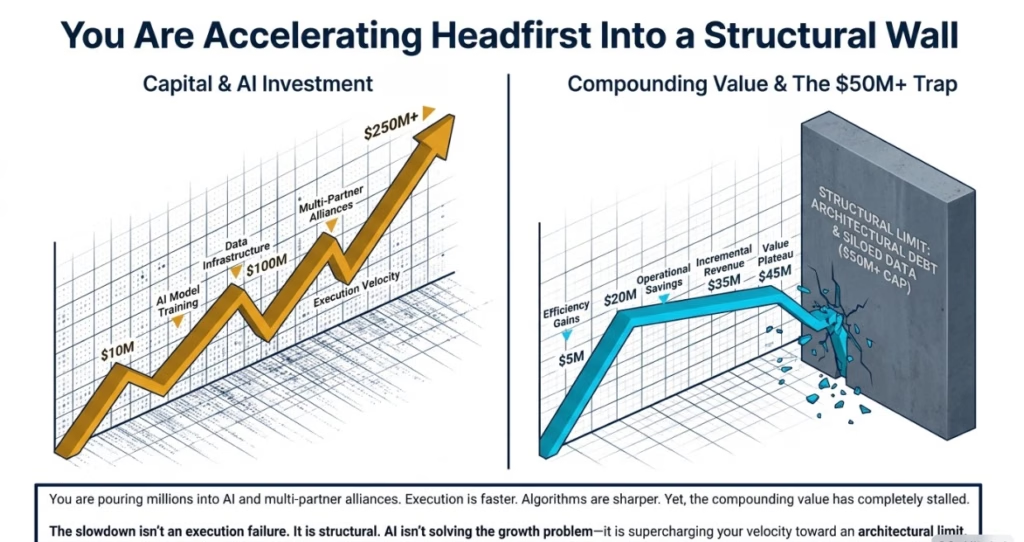
The Tension: Enterprise leaders routinely ask: “We built the digital platform, secured major industry partnerships, and connected our data flows—so why isn’t alliance value compounding as expected?”
The Cause: Organisations fall into The $50M+ Ecosystem Trap by applying traditional platform control, gatekeeping, and static calendar-based governance to complex, multi-partner networks.
The Outcome: Transitioning from rigid coordination to dynamic orchestration allows independent actors to generate emergent value that no single central manager could direct alone.
The Four Invisible Ceilings faced and why Enterprises Scaling Stalls
1. Executive Briefing
The Tension: Major enterprise organisations are pouring unprecedented capital into digital platforms, AI sensing, and partner ecosystems, yet execution speed isn’t yielding growth. Instead of compounding value, initiatives hit performance ceilings that traditional management tools cannot diagnose.
The Cause: Scaling beyond organisational boundaries using legacy corporate architecture forces multi-partner networks into four invisible ceilings: The Velocity Illusion, The Intelligence Plateau, Governance Inertia, and Capital Erosion.
The Outcome: Unlocking compounding network value requires moving away from linear platform management toward a dedicated ecosystem architecture that bridges dynamic orchestration and adaptive governance.
The Need for a Unified Ecosystem Architecture- how value is created
Executive Briefing: Modern enterprise value creation has crossed an irreversible threshold. The defining industrial and technological challenges of our era—decarbonisation, connected care, resilient multi-tier supply chains, and cross-domain AI—cannot be solved within the legal or operational boundaries of a single firm.
Yet, enterprise leadership teams continue to deploy 20th-century linear management tools, gatekeeping platforms, and bilateral vendor contracts to govern multi-actor networks.
The resulting friction is not an execution failure; it is an architectural failure. This paper establishes the structural blueprint for the Intelligent Integrated Business Ecosystem (IIBE)—the missing layer that transforms fragmented partner networks into continuous, compounding intelligence engines.
Overcoming the internal friction that frustrate our ambitions
EXECUTIVE SUMMARY Traditional growth strategies fail in multi-actor environments because they apply linear management tools to non-linear network dynamics. When growth stalls, the cause is rarely poor execution—it is structural friction embedded in how data, governance, and capital flow across organizational boundaries.
Here is a self-diagnostic to find out your position and recognise your friction points that need resolving.
What is holding many of our larger organisation back in their Ecosystem approaches? Looking at different organisations recently in my research (and ecosystem approach) they all seem to have common approaches of active recruiting of ecosystem partners, offer developer / API portals and have structured co-innovation tracks but they are all being held back, choking off unexploited synergies from a lack of a holistic Ecosystem approach.
The highest-value opportunities in modern industrial markets occur at the ecosystem boundary lines where data, AI agents, independent software and multi-entity governance intersect and most internal teams struggle to capture these opportunities because corporate structures are built for execution and not for ecosystem sensing. This strategic blindspot needs resolution.
For some reason there are so many blind spots that organisations do not surface in unexploited partner synergies and then be able to deliver validated “investable options” back to their leadership team.
ExecutiveDecision Map and the Sequence to avoid the Five Costly Mistakes
The important five decisions that determine whether your ecosystem architecture compounds value or merely connects partners Are you on a path of emergence or ignoring root problems?
Most ecosystem strategy documents explain what an ecosystem is. This one does not. It starts where you are: in the room with a decision that has organisational consequences, a board that wants clarity, and partners who are watching what you do next.
The two sections that follow identify the five decisions organisations consistently get wrong — and the sequence of executive decisions that gets them right. They are written for CEOs and the four C-suite roles that carry ecosystem architecture into operation
IsASML the gold standard of an Ecosystem Orchestrator? They did not build the world’s most advanced Extreme Ultraviolet (EUV) lithography systems by acting as a traditional vertical manufacturer or a gatekeeping platform—they built it by constructing a transnational ecosystem bound by precise Control Points.
ASML effectively proves that when an ecosystem spans global geographic borders, it isn’t just held together by ownership or rigid contracts; it is held together by shared intelligence, mutual dependence, and systemic control points and significant trust and confidence.
Deconstructing ASML Through the Ecosystem Formula
I have been recently looking at different Ecosystem formula’s and this one brings out the Orchestration equation
The Living Bridge required for Ecosystem Management
Recognising the Living Bridge needed for Ecosystems
The Living Bridge governs Dynamic Orchestration — it is not Dynamic Orchestration itself
Dynamic Orchestration is the governance capability that operates within the ecosystem — reading diagnostic signals, operating the Intelligence Engine, managing emergence conditions. It is designed to become progressively less necessary: the more it works, the more the ecosystem carries its own coordination. Its transfer into the ecosystem, over time, is the whole point of it.
The Living Bridge is different, and has to stay different. It operates above Dynamic Orchestration — not as its practitioner, but as the meta-governance function that determines how, where, and when the architecture gets applied to a given ecosystem in the first place.
So what is the Living Bridge from an Ecosystem Management perspective?
Not a person-dependency in the sense of daily operation. Not a proprietary lock-in either. It is the interpretive function that:
Reads the structural reality of each unique ecosystem with diagnostic precision — before any construct is applied
Holds the tension between AI sensing and human meaning-making in productive relationship
Calibrates which parts of the architecture apply, and when, to this specific ecosystem’s maturity and complexity
Governs Dynamic Orchestration’s transfer into the ecosystem — deciding when DO is ready to be handed over, not handing itself over
Does not transfer. Its permanence is what makes the transfer of DO trustworthy rather than premature
Dynamic Orchestration is what transfers. The Living Bridge is what decides when, how, and whether it should. DO’s measure of success is how little it’s needed inside the ecosystem over time. The Living Bridge’s measure of success is different: whether the right architecture reached the right ecosystem, at the right moment, in a form that actually held.
This is governance as enablement — for Dynamic Orchestration. And governance of governance — for the Living Bridge. Two functions, two different success conditions, operating at two different levels.
Ask any CFO what happens when a factory machine, a truck, or a software license gets used every day, and they will give you the standard accounting answer: It depreciates. It wears down, loses value, and eventually gets written off.
Now ask that same CFO how they balance sheet a multi-partner AI network, a shared data infrastructure, or a collaborative industry ecosystem. They will apply the exact same logic. They will mark it down as an operational cost or let it depreciate.
Also how many times have you found your development project, full of future potential, get stopped because of funding constraints or annual reviews and that constant questioning of “where is the return of investment?” Yet the promise, learning and exploring new avenues of intelligence have all been deemed as a full cost and fully depreciated, not recognised for their future value of the knowledge gained.
Does that make sense? When something improves, expands in knowledge and the more it is “used” it appreciates in understanding and value yet it gets the depreciate treatment.
This is a massive financial paradox.
Enterprises are pouring billions into artificial intelligence, multi-actor alliances, and dynamic supply chains, yet they evaluate these investments using accounting rules invented during the Second Industrial Revolution. We are running 21st-century intelligent ecosystems on financial models built for factories and accounted for with rules invented during the Second Industrial Revolution.
From Flow to Knowledge provides New Emerging Value
Emergence occurs when we are converting Ecosystem Intelligence into Knowledge and Value
The architecture that breaks through the four invisible ceilings does not replace what organisations have built. It elevates it — transforming accumulated intelligence into flowing knowledge, that provides the new value that compounds with every actor the network touches making their contributions.We are achieving the power with Ecosystems
Emergence:Converting Ecosystem Intelligence into Knowledge and Value
It is not always visible when it happens. The investment continues. The partnerships are active. The platforms are performing. The AI is deployed. And somewhere in the gap between what the ecosystem is producing and what the original ambition implied it would produce, a different question begins to form — not how do we do this better, but what does this become when it is designed differently.
This is the third part of a three part series : From Flow to Knowledge: Moving Ecosystem Intelligence into Value
This post three delivers the architectural answer — the transition from accumulation to flow, fusion as what flow makes possible, the Living Bridge as the institutional function that holds dynamic orchestration and adaptive governance together, and emergence as what becomes possible when the design is right. Closes with the invitation rather than the prescription.
Here we explore what the Sensing-Meaning-Flow diagnoses within the ceilings that are presently stopping an organisation to “break through” and build new value. Applying a sequence of Flow-Fusion-Emergence breaks through it and converts what was stalling into compounding knowledge value. What emerges converts Intelligence into Knowledge and new Value that looks to Compound.
This sits within the beating core of the IIBE framework, its intelligent engine