IIBE's connective tissue: Signals → Meaning → Relationships → System Dynamics → Choices → Adaptation → Learning → Renewed Sensing
Ecosystem Orchestration & Operating Models
Explore the orchestration skills, roles and dynamic governance structures required to coordinate partners, integrate capabilities, and run high-performing ecosystems.
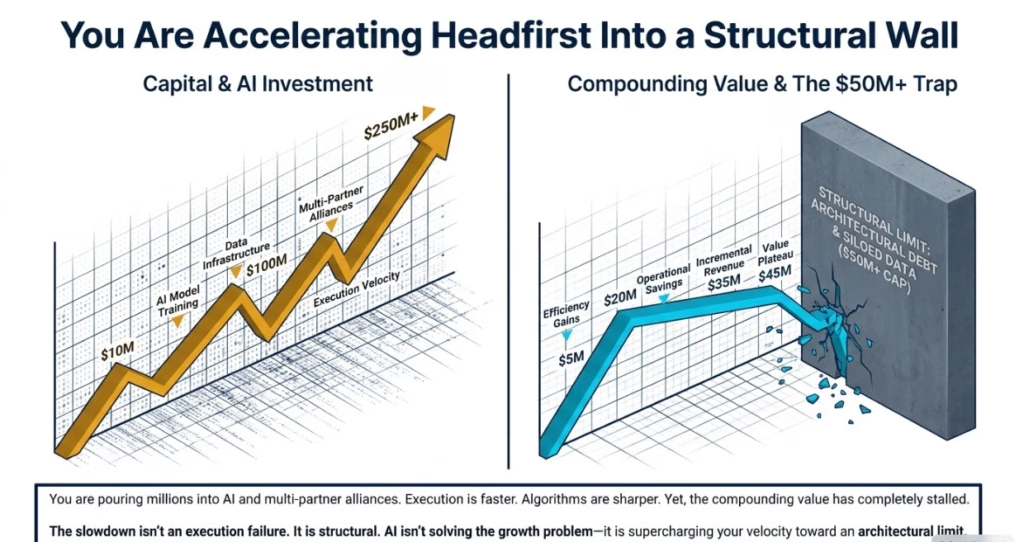
The Tension: Enterprise leaders routinely ask: “We built the digital platform, secured major industry partnerships, and connected our data flows—so why isn’t alliance value compounding as expected?”
The Cause: Organisations fall into The $50M+ Ecosystem Trap by applying traditional platform control, gatekeeping, and static calendar-based governance to complex, multi-partner networks.
The Outcome: Transitioning from rigid coordination to dynamic orchestration allows independent actors to generate emergent value that no single central manager could direct alone.
Executive Briefing: Across every global sector, enterprise executive teams are experiencing a subtle, unsettling phenomenon. Deals that should be straightforward wins are slipping away.
Established market leaders—holding superior technology, deeper balance sheets, and decades of domain authority—are routinely losing ground to rivals whose individual capabilities are demonstrably weaker.
This is not an execution failure, a pricing misstep, or a marketing deficit. It is the signature of a fundamental market shift: the unit of competition has changed. Competition is no longer an arena of isolated firm against isolated firm.
It has become a contest of collaborators within one ecosystem architecture against ecosystem architecture in another
This paper serves as a strategic mirror for enterprise leadership, dissecting why single-entity strength has become a vulnerability and detailing how the Intelligent Integrated Business Ecosystem (IIBE) transforms organizations into invincible collaboration hubs.
The wrong logic on platforms, they build the wrong strategy
Executive Briefing: Over the past two decades, enterprise strategy has been dominated by the doctrine of the platform. Inspired by the massive market valuations of Big Tech hyper-scalers, industrial conglomerates, pharmaceutical giants, and global logistics providers have invested heavily in building digital platforms, App Store portals, and developer APIs.
Yet, across enterprise after enterprise—Siemens AG, Novartis, Roche, Maersk, ABB, and Schneider Electric—a familiar pattern emerges: ballooning technology spend accompanied by diminishing network returns.
These organizations are experiencing the Platform Fallacy. Platforms were designed for centralized gatekeeping, transactional volume, and single-entity value capture. When applied to complex, multi-actor business environments, platform logic acts as a constraint. This paper exposes why legacy platform logic fails and details the transition to the Intelligent Integrated Business Ecosystem (IIBE).
Executive Briefing: Across every major industry, enterprise leadership teams have reached problem recognition. They sense that linear supply chains, bilateral partnerships, and centralized platforms are no longer sufficient to solve multi-actor challenges.
Yet, despite millions invested in digital platforms and alliance programs, the system continues to resist. This resistance is not an execution failure or a lack of strategic ambition; it is an architectural gap.
Executive Briefing: For over half a century, executive management education, management consulting, and capital allocation models have been organized around a single imperative: scale.
When enterprise leaders encounter a promising innovation, a strategic partnership, or a digital initiative, the immediate directive is uniform: “Optimize it, standardize it, and scale it.”
While this logic generated unprecedented wealth in 20th-century manufacturing and linear software delivery, it has become one of the most destructive forces in modern business strategy. Modern value creation has crossed a structural threshold.
When applied to multi-actor networks, legacy scale logic produces friction, erodes partner trust, and stalls transformation. This paper exposes the hidden flaws of industrial scale logic and outlines the compounding framework of the Intelligent Integrated Business Ecosystem (IIBE).
The Need for a Unified Ecosystem Architecture- how value is created
Executive Briefing: Modern enterprise value creation has crossed an irreversible threshold. The defining industrial and technological challenges of our era—decarbonisation, connected care, resilient multi-tier supply chains, and cross-domain AI—cannot be solved within the legal or operational boundaries of a single firm.
Yet, enterprise leadership teams continue to deploy 20th-century linear management tools, gatekeeping platforms, and bilateral vendor contracts to govern multi-actor networks.
The resulting friction is not an execution failure; it is an architectural failure. This paper establishes the structural blueprint for the Intelligent Integrated Business Ecosystem (IIBE)—the missing layer that transforms fragmented partner networks into continuous, compounding intelligence engines.
Today we learnt that Schneider Electric has agreed to buy PTC. The implications and question only start being raised. Is this audacious or necessary?
Schneider Electric has agreed to buy PTC for about $22.6 billion in cash, a 42.3% premium to its last closing price, with closing expected by Q3 2027 subject to a PTC shareholder vote and regulatory approvals.
To quote With PTC, Schneider Electric is adding CAD and PLM software to its portfolio. “Together, we are creating the industry’s most complete Software & AI powerhouse and highest-quality portfolio bridging the physical and digital worlds.” ,” said CEO Olivier Blum.
Schneider is buying the design half of a “digital thread” whose operations half it already owns through AVEVA and is assembling through Cognite. A digital thread, in vendor usage, is one connected record of a product from CAD model through manufacturing and service. The announcement describes the goal as “a unified digital thread fuelled with a contextualized AI Data Foundation across products & machines and processes & energy systems.“
The price is the smaller story. Schneider’s CEO said PTC’s engineering and design data would strengthen Schneider’s ability to deploy AI across customers’ industrial operations. A layer that sat between vendors is becoming owned infrastructure, and every party now asks the same thing: who holds the data, and on what terms?
What is holding many of our larger organisation back in their Ecosystem approaches? Looking at different organisations recently in my research (and ecosystem approach) they all seem to have common approaches of active recruiting of ecosystem partners, offer developer / API portals and have structured co-innovation tracks but they are all being held back, choking off unexploited synergies from a lack of a holistic Ecosystem approach.
The highest-value opportunities in modern industrial markets occur at the ecosystem boundary lines where data, AI agents, independent software and multi-entity governance intersect and most internal teams struggle to capture these opportunities because corporate structures are built for execution and not for ecosystem sensing. This strategic blindspot needs resolution.
For some reason there are so many blind spots that organisations do not surface in unexploited partner synergies and then be able to deliver validated “investable options” back to their leadership team.
Stand-alone software is no longer enough to win in today’s industrial market? In fact, rigid platforms that guard their borders actually throttle innovation and slow down progress. The future belongs not to the isolated giant, but to the most responsive, interconnected network.
Beyond the API: The Rise of Dynamic Ecosystems
Most software platforms designed today stop at basic integration—they connect a few APIs, call it an “ecosystem,” and stop there. But true business value breaks down at the boundary lines. In a real-world building environment, decision-making authority is shared across a complex web of building owners, tenants, utility grids, and third-party AI software.
Inside your own walls, accountability is a known shape. A name against a target, a reporting line, a review that eventually catches what went wrong. It isn’t always comfortable, but it is clear: you know, more or less, where it sits.
Accountability at the Edge is different : The Design Principles for Ecosystems Beyond Hierarchyneed to be clarified and explained
Something different happens at the edge. A shared commitment with an external partner starts to slip. A joint decision needs making, and no one is quite sure whose call it actually is. A disagreement surfaces between two organizations that both have a stake in the outcome, yet neither has authority over the other.
The shape that worked so cleanly inside your own walls simply doesn’t reach. You can’t put a name against it the old way, nor can you escalate it to someone who can just decide. The line runs out exactly where you need it most.
What’s needed at the edge isn’t a longer line reaching further out. It is a different understanding of what accountability actually looks like once it has to be shared rather than assigned.