
1. Executive Briefing
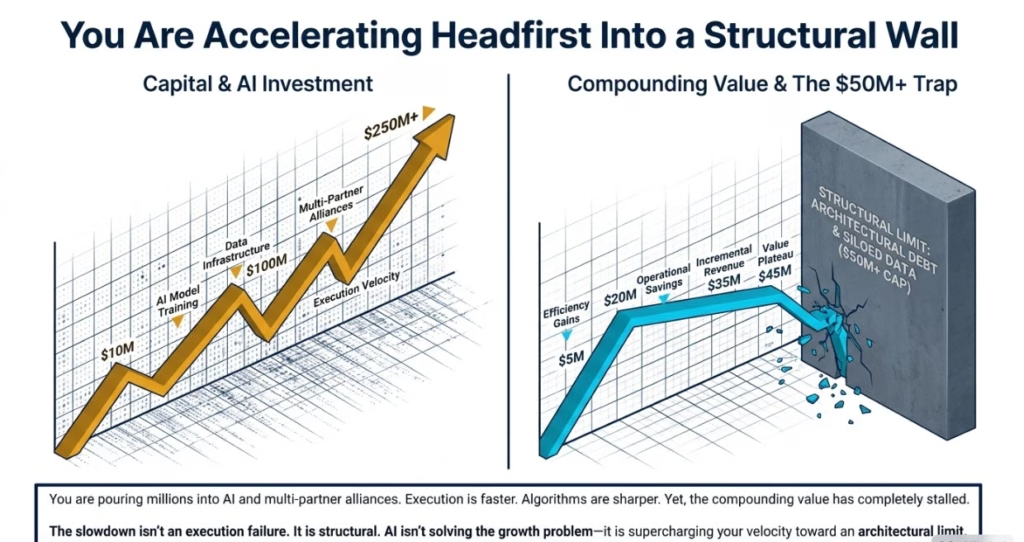
The Tension: Enterprise leaders routinely ask: “We built the digital platform, secured major industry partnerships, and connected our data flows—so why isn’t alliance value compounding as expected?”
The Cause: Organisations fall into The $50M+ Ecosystem Trap by applying traditional platform control, gatekeeping, and static calendar-based governance to complex, multi-partner networks.
The Outcome: Transitioning from rigid coordination to dynamic orchestration allows independent actors to generate emergent value that no single central manager could direct alone.
2. Comparative Table: Coordination vs. Orchestration in High-Value Alliances
| Governance Dimension | Alliance Coordination (The Trap) | Alliance Orchestration (The Solution) |
| Pillar Alignment | Linear Partnership Management | Pillar 3: Operational Execution & Governance (The Rules) |
| Core Operating Logic | Centralised control, gatekeeping, and risk avoidance | Shared control points, open signal routing, and joint value creation |
| Relationship Scope | Manages known partners toward known outcomes | Orchestrates conditions for unknown synergies to emerge |
| Governance Structure | Fixed annual reviews and rigid contract enforcement | Dynamic orchestration held by meta-governance (The Living Bridge) |
| Financial Outcome | Operational friction and capital erosion | Compounding network returns and appreciating ecosystem assets |
3. Deep Dive
When major enterprises invest $50M+ into multi-partner alliances, platforms, or collaborative technology networks, they frequently confuse coordination with orchestration:
- Coordination manages known relationships toward known outcomes. It optimises existing processes, but it quickly hits an invisible ceiling.
- Orchestration creates the structural conditions under which independent actors discover each other and generate unexpected, compounding value without central micromanagement.
The Root Cause: The Platform Fallacy
For two decades, software platforms taught enterprises the wrong ecosystem logic: central control, strict gatekeeping, ownership of data flows, and rigid rules designed solely to protect the core. When this platform mindset is applied to multi-partner strategic alliances, it creates a brittle governance spine. Partners pull back, data sharing slows to a trickle, and unexploited synergies choke.
Breaking the Governance Inertia
To unlock compounding returns from major alliances, enterprise leadership must implement Adaptive Governance:
- Decouple Meta-Governance from Daily Operation: Establish a functional governance capability—the Living Bridge—that evaluates ecosystem health and signal quality without bottlenecking daily operational decisions.
- Shift Focus to Control Points Over Total Ownership: Focus governance on critical, shared control points and data interfaces rather than attempting to control partner behavior.
- Enable Edge Accountability: Distribute decision-making authority to the boundary lines where partners, clients, and AI sensing intersect.
🌐 Explore the Full Architecture
This diagnostic analysis sits at the intersection of pone of my core Pillars: Operational Execution & Governance (The Rules) and Pillar 2: System Mechanics & Dynamism (The Engine).
- 🌐 For Operating Rules & Tools: Visit our Operational Execution Reference Tab on
ecosystems4innovating.com. - 📐 For Blueprint Mechanics: Explore the IIBE Architecture & Blueprint Overview on
paul4innovating.com.
Unwind the Platform Fallacy
Is your digital platform strategy trapping your organization in a rigid growth ceiling? Connect with Paul Hobcraft on LinkedIn to discuss the right approach to overcome the Platform Fallacy or schedule a call for organisîng an executive alignment briefing.