

1. Executive Briefing
The Tension: Major enterprise organisations are pouring unprecedented capital into digital platforms, AI sensing, and partner ecosystems, yet execution speed isn’t yielding growth. Instead of compounding value, initiatives hit performance ceilings that traditional management tools cannot diagnose.
The Cause: Scaling beyond organisational boundaries using legacy corporate architecture forces multi-partner networks into four invisible ceilings: The Velocity Illusion, The Intelligence Plateau, Governance Inertia, and Capital Erosion.
The Outcome: Unlocking compounding network value requires moving away from linear platform management toward a dedicated ecosystem architecture that bridges dynamic orchestration and adaptive governance.
2. Comparative Table: Legacy Scaling vs. Ecosystem Architecture
| Dimension | Legacy Platform Approach | IIBE Ecosystem Architecture |
| Pillar Alignment | Static Platform Management | Pillar 1: Core Theory & Architecture (The Blueprint) |
| Scaling Mechanism | Linear expansion via APIs & central control | Multi-actor network flow and compounding knowledge fusion |
| Governance Model | Rigid, calendar-driven corporate compliance | Adaptive governance via dynamic orchestration (The Living Bridge) |
| Intelligence Flow | Trapped in isolated functional or divisional silos | Continuous sensing-meaning loops across organizational boundaries |
| Value Trajectory | Diminishing returns & friction cost erosion | Compounding value appreciation across connected partners |
3. Deep Dive
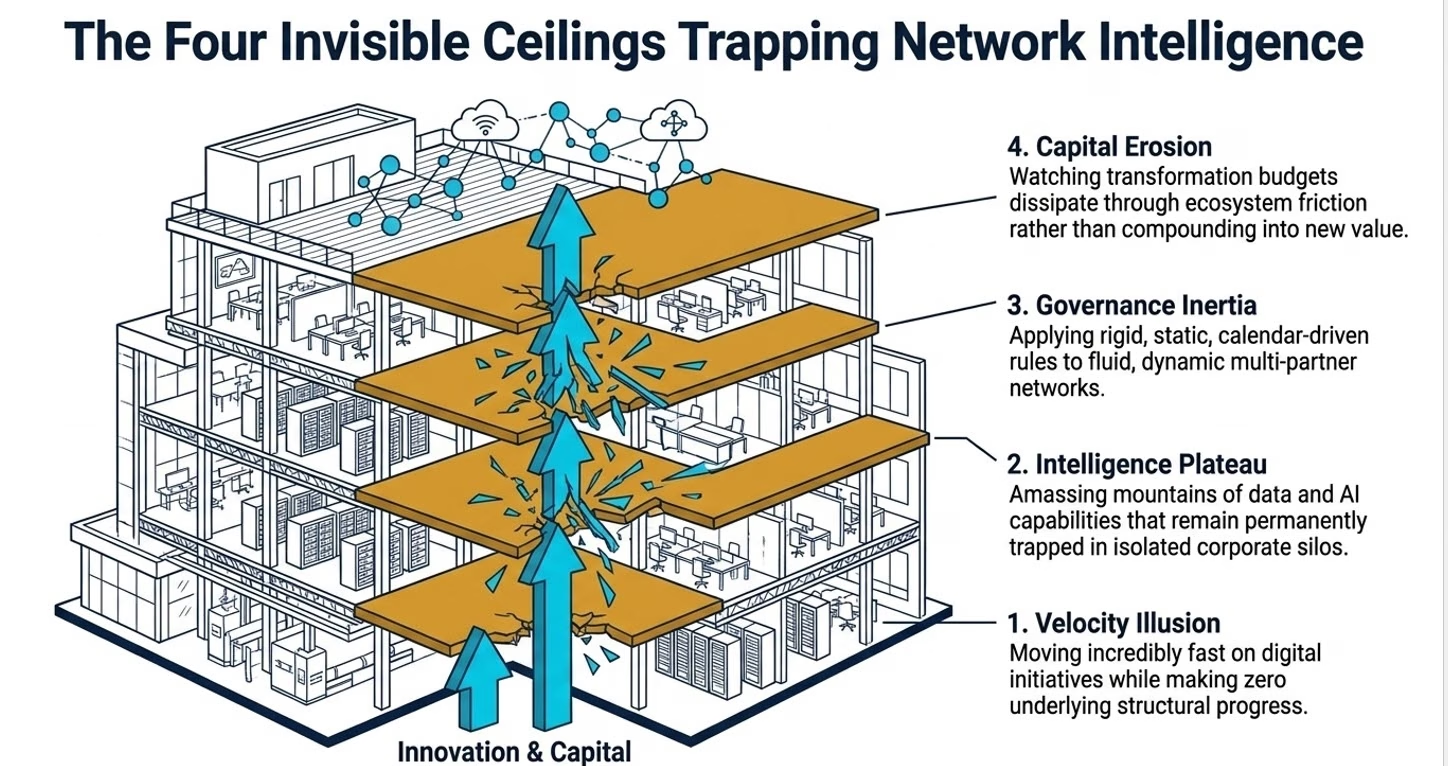
Right now, global enterprises are accelerating their digital investments. Execution is faster than ever, and data models are sharper than ever. Yet executive teams face an alarming paradox: spending is skyrocketing, but compounding value has stalled.
AI and platform investments are not solving the growth problem on their own—they act as superchargers that deliver organisations into structural brick walls faster. Without a dedicated ecosystem architecture, multi-actor strategies inevitably crash into four invisible ceilings:
- The Velocity Illusion: Moving fast on isolated digital initiatives while making zero structural progress across organisational boundaries.
- The Intelligence Plateau: Amassing mountains of partner data and AI capabilities that remain trapped in isolated silos, unable to inform cross-company decisions.
- Governance Inertia: Applying rigid, calendar-driven internal compliance rules to dynamic, multi-partner networks.
- Capital Erosion: Watching transformation budgets dissipate through ecosystem friction rather than compounding into new market advantages.
To break through these ceilings, organisations must shift from treating partner networks as mere extensions of their internal supply chain to designing a coherent Intelligent Integrated Business Ecosystem (IIBE). When architecture aligns capabilities, intelligence, and value creation across independent actors, ecosystems move from fragmented relationships into adaptive, self-improving systems.
🌐 Explore the Full Architecture
This post highlights a core tension within one of my four Pillars: Core Theory & Architecture (The Blueprint) of the IIBE framework.
- 📐 For Structural Foundations: Explore the IIBE Blueprint Overview on paul4innovating.com.
- 🌐 For Governance Rules & Operating Models: Access the Operational Execution Reference Tab on ecosystems4innovating.com.
Which of the four ceilings is your organisation hitting right now?
Lets explore solutions to your needs, contact me