Where New Ecosystem Thinking Is Explored, Tested and Shaped
designing the future of innovation
Innovation needs to be designed differently, it is through a more collaborative approach and placing platform and ecosystem thinking into your process and understanding will deliver improved innovating performance
Recently, well actually, over the past twelve or eighteen months, I was asked to explore and explain different frameworks that the innovator might need to know, or at least have an opinion upon.
Some of these investigations or explanations were fairly long so I decided to not reproduce them here but to have an opening summary and then set up the links onto their site for you to read the ones that are of interest or curiosity to you.
So far I have covered ones that were asked for, there are a few more that need covering or even deepening out in explanations in my mind, lets see.
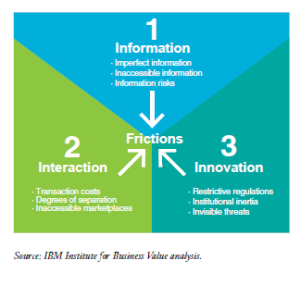
I was reading a report by the IBM Institute for Business Value’s “Fast Forward: Rethinking enterprises, ecosystems, and economies with blockchains”. In IBM’s thinking, they have clearly taken friction as part of the need to be broken down within any rebuilding of the supply chain. Well, I also believe these apply equally as innovation frictions. Reducing any frictions that get in the way is good, right?
So I decided to builds out of their friction analysis, building on the thoughts offered in the report, adding the innovation perspective.
So here I am suggesting constraints that need tackling in reducing the innovation friction points, theirs was for blockchain. I did like a comment in the report stated: “Friction, in theory, could be digitized away” (page 3) and partly why I looked at the report in this digital perspective for future facing innovation solutions. The frictions hold true for innovators to resolve.
There are multiple “stretching and straining points” that make the life of the innovator increasingly uncomfortable. These build into increasing frictions where the eventual performance of innovation seemingly disappoints the leadership of organizations. So why is that?
It is only when we can truly understand the constraints innovation works under, can we provide more robust solutions to reduced all these frictions and pain points that innovators are struggling with. There are many.
We often can’t seem to break down the rigidity win the organization’s system, to allow innovation to speed up, connect and deliver on its promise. Organizations continue to struggle with obtaining that higher level of agility and flexibility required for innovation speed of response and delivery.
The culture within organizations still is rather more closed-up into the silo mindset and not encouraged to be more open, engaging across functions in collaborating ways. We attempt co-creation to test ideas and try to deploy these but they come against institutional resistance to change. We continue to rely on emotional and gut decision-making and still have not fully embraced the data-driven cultures to make more informed decisions. All these constraints create that pressure to perform. So much around innovation is not optimal.
I firmly believe we are on the cusp of a new innovation era.
When you step back and recognize all the different advancements we have been making in designing tools and frameworks, and in understanding innovation, it holds promise.
Yet it is this recognition that the present is not working anymore with existing innovation systems, you do need to search for a real lasting change that does transform and connect all the parts into a new innovation designed ‘whole’. There are a number of intersections and driving forces that are coming together and what is emerging is this new innovation era. Now we have to weave them together.
Of course, much of what we have will still remain. We are still in need of finding innovations that provide new products, services or business models. These outcomes remain constant, it is the way we approach these that is in need of being seen as dramatically different. We require a more evolutionary, fresh perspective.
The sad part is that many of our existing consulting firms offer solutions that are unfit for today’s needs, or ill-equipped for offering advice on tomorrow’s purpose and the designs necessary. Equally, nearly all our larger business organizations are still locked in the past or attempting to catch up to the present but in random ways. This does need a real change but can we achieve it?
Innovation is advancing but most of it has been designed for a different time, the old era of stable markets, predictable solutions and having a clear sense of your competition. All that has changed dramatically. We have all been trying (very hard) to stay relevant in an ever-increasing uncertain world, applying solutions left over from a past era. Something has had to suffer and I believe this is our innovation outcomes, that are not shifting the growth needle as we keep our innovation systems and thinking trapped in the 20th-century mindset.
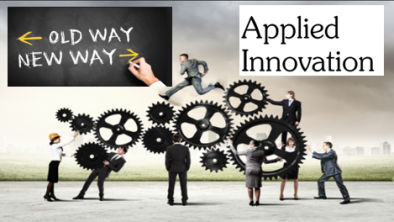
I wrote a post “Needing to Think Applied Innovation Services” recently, it was extending my view that innovation needs to change. We need to think of managing innovation in different ways, we need to automate it and in addition, augment it. I suggested in that post “we need to pull down what is needed” and design a totally ‘adaptive’ innovation process to fit a specific need.
I argued we need to think differently about how we manage innovation. It needs to be more radical in design, actually, it needs to be far more up to date and in tune with the technology progress we recommend so much to others! Innovation systems are lagging, they should be leading in their design and connectivity.
What I mean by this is it needs to begin to ‘account’ for cognitive solutions that can augment and help automate our present highly manual innovation systems. I know we have some good software for different parts of the innovation process but none of these are integrated, fully connected up in their design. We still work in piecing them together. We lose significant collaborative opportunities and speed due to this mostly disjointed innovation approach. Surely this has to change?
We need to bring innovation and its process up to date. With cognitive computing, artificial intelligence, cloud-based solutions, purposefully designed apps and specific tools and frameworks, we do need to begin to stretch our imaginations further and flex our technology and app solutions more towards providing a better, more connected innovation process. I want to see a new innovation era happen.
We can simply go on and on in the many ways we have evolved our problem-solving techniques or methodologies, as those help the innovation and discovery process; incremental, piecemeal and experimentally.
Yet we still get caught out by not resolving or addressing the essential building blocks of innovation (culture, environment, climate, governance, alignment). We have never ‘cracked’ the full innovation management system. Perhaps we can today. We should try at least.
Many of those innovation tools that have been emerging in recent years have now built up a powerful body of validation, and they become necessary to know and practice yet often miss the basic building block needs of innovation. We need to do better, we need to design a completely new innovation process that takes into account all that has evolved in our understanding and experiment in recent years. Some thoughts:
Core capabilities have upsides and downsides. As many of our business organizations seek to optimize their processes across the company, they are constantly reaching more outside to gain growing partnerships and greater innovation interactions. They are looking to complement and reinforce existing capabilities through more open innovation thinking and approaches but is that enough?
One focus area is on value chain optimization, another on customer engagement, yet the one that has the potential to really transform the innovation process lies in the partnerships emerging from reaching back into established suppliers, but also by tapping into the broader network of knowledge that can be found in reaching out to the innovation community of start-ups, venture capitalists, research institutions and other key players, capable of fostering and delivering innovation in unique and diverse collaborations. The collaborating edges are becoming our new core.
The core is far more found at the edge, in the collaborating capability and networks we form and this needs very different organizational design.
The significant transformation taking place around exploiting technology and digital management has made ecosystems and platforms a mainstream prospecting need, in most of our businesses today. We must engage in what all of this means and its business impact.
I certainly believe the ecosystem approach will increasingly become the main value-producing stream for innovation delivery. Platforms, strategic partnerships, new business models all will be on the agenda of any serious global organization and ecosystems through platforms are the organizing environment to enact these.
We so often get caught up in the building of our capabilities. In some ways, I keep attempting to “peel the innovation onion” in explaining the need to focus on building the capabilities in different ways but to be honest, it needs these various approaches to an ever-changing environment.
A different intensity of innovation onion perhaps? Why, well we have the business of today, the emerging business of tomorrow and the future business that will provide a radically different set of capability building needs?
The struggle to date is that innovation remains hard to manage well; we strive to systematize it and then attempt to replicate any success we then have, so as to achieve more, yet more often than not. we do not take into account all the variables that came together for that particular winning outcome. Often this does not work on a repetitive basis as the variables that make up innovation can be different for each innovation event or activity but we can learn under a growing ‘range of’ differentiating capabilities.
Innovation often fails to align to the strategic needs. This is often not the fault of the innovator.
Many innovators are simply happily working away with no specific guidelines, apart from the general remit of “we need to be more innovative”, it lies in the boardroom that is not communicating the board’s needs clearly enough down the organization.
Building up our capacity to innovate does need to understand and reflect the organization’s business activities, as innovators need to grasp the value creation aspects that will deliver the necessary capital-efficient and profitable growth, and then ‘go in pursuit’ to achieve their contribution to these goals.
Even the basic questions often remain unclear, those of how are we looking to grow revenue, save costs, reduce working capital or improve our fixed capital? Managing our innovation activities can help in all of these. Actually if you ask I expect the CFO would say “all of them” but each does have implications on understanding of the fit and eventual role of innovation’s contribution.

 Recently, well actually, over the past twelve or eighteen months, I was asked to explore and explain different frameworks that the innovator might need to know, or at least have an opinion upon.