
Today, we are increasingly recognising that modern business does not behave like those linear systems we designed in the past years.
The need for business ecosystems cannot evolve through sequential design, not can they fully be understood through decomposition into isolated parts. Their behaviour emerges through interaction, adaptation , and continuous reconfiguration across multiple structural dimensions.
We have to learn these, we have to adapt and that growing recognition that conventional analytical and management approaches were not designed for this complexity.
Do you feel that growing tension?
Tension: You have evidence of interest without commitment and you have the barrier in reluctance to change. Pricing isn’t the obstacle yet.
Cause: That real reluctance to change the business model as you can’t afford disruption at this time and you have no capacity to undertake such a shift. Yet markets are rapidly changing
Outcome: Business Ecosystems are not today’s priority and most probably in many executives view AI alone will fix this. It will not!
The IIBE was developed in response to this gap- not simply as another framework but as a discipline for working with ecosystem complexity in its natural form.
There are some real responses here. Staged commitment can resolve these.
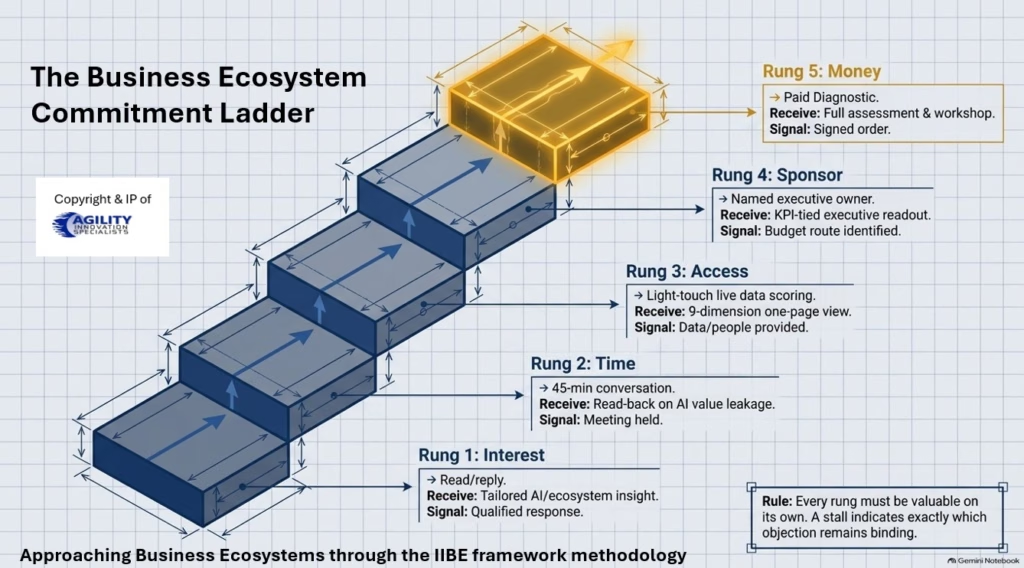
There is a view that applying a ecosystem commitment ladder would enable this. It is determined, each rung at a time, that requires needed evidence to show its worth of that step or it should stop there. A prospect that takes the steps up that commitment ladder has chosen to, and a prospect that stalls tells us exactly which objection is still binding and holding them back. The “exchanges” form the necessary first step in Ecosystem design and thinking.
Building business ecosystems into your current business model can have staged entry steps, as overlays on the current model, the evidence builds by anchoring every output on gains in potential in revenue, margin, cycle time, retention, knowledge building, market realisation.
The need is to overcome the tensions and barriers in staged ways..
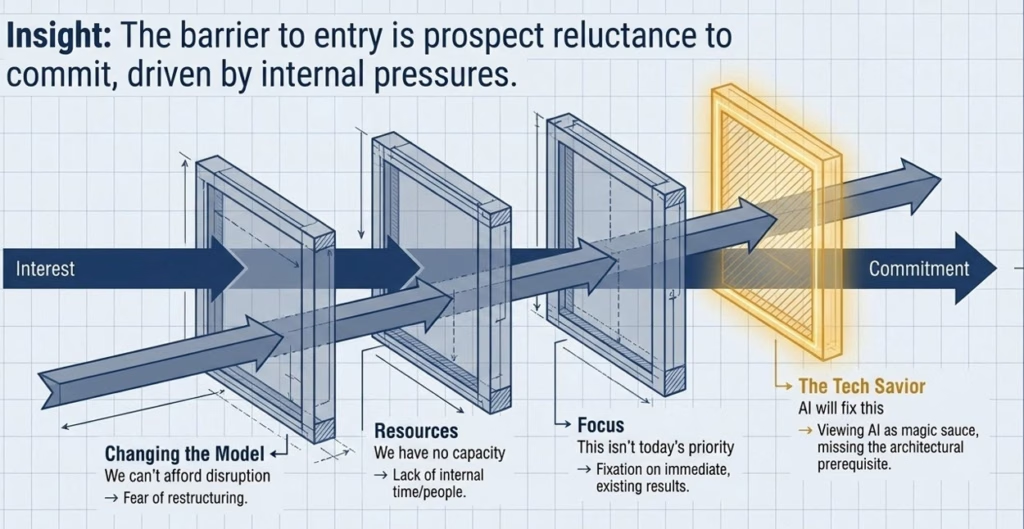
Changing the Business Model, finding those resources can have a “real ask” in hours and people upfront and as evidence builds, resources can be reassigned in most cases. Applying AI alone does not fix the “need,” it is really only the amplifier, without ecosystem architecture, it can accelerate existing weakness as readily as strengths. It is a combining that enables.
Applying diagnostics and discoveries enables that architecture to become the scaffolding needed.
So within this commitment ladder you have the following
- Intent: They read it, they understand or need clarification, reply, calls the work relevant and needed. Opening exploration.
- Time: Moving firstly into a one focused conversation (about 45 minutes) they have a real working session to give the sense and recognition
- Access: They share data, people (initially for a few hours) or tackle a live problem to achieve a light-touch scoring across nine dimensions with a one page view that provides clear evidence signals that ecosystems have their place and value
- Sponsor: A named executive owns the next step, someone with the authority that names this as a priority and can provide a clear readout tied to existing KPIs
- Money: Recognising this has value to explore and provides a paid diagnostic to validate and be, the gate required to unlock subsequent staged commercialisation prospects.
This commitment ladder can do the job of reducing the tensions by building genuine interest, a growing willingness to make “staged” change, begins to recognise the business model can evolve and the evidence work does determine finding capacities and shifting a growing focus on what Business Ecosystem thinking and design can offer combined with AI.
The proof, we come back to the rungs of the commitment ladder: each rung carries its offer, its objection answer and its evidence signal. This is acceptance testing when done genuinely.
So market acceptance becomes the arbiter of the IIBE’s commercial value. The stages are designed to be measurable, to provide a useful addition to the business on its own and produces a distinctive evidence signal, that may take a prospect through a 18- 24 month acceptance model or simply leaves it at the observed market evidence stage due to their realities of the business today.
So lets clarify the stages.
Recently these were outlined here: From First Conversation to Decision: Staging your Ecosystem, in deliberate design that is intentional rather than accidental, elevating ecosystem activity from observation to systemic design. I do recommend this is highly informative in the stages the IIBE can go through.
Every stage answers different questions. These are module and progressive on your recognition of their value. You stop when you cant see progression up that commitment ladder.
- Progress milestone: what exists at the end of this stage that did not exist before?
- Value tracked: what has been learned or clarified, and for whom? In emerging value and growth opportunity
- Decision gate: what must the client decide before going further? Deciding sequence
- Flag: what implication, risk or mismatch has surfaced that should not be carried forward silently?
Stage 1a: Entry touchpoints (lighter, open, low commitment). Pre-Engagement
There is a pre-engagement discovery that explores the level of the organisations appetite, understanding of ecosystems and current capability. Workshop and one-to-one coaching are other ways in. The read-out ends with a choice of next doors, not a single push.
Stage 1b: Deepening the Mandate and Appetite (building any pilot or partner commitment)
A common and costly pattern is that a team is allowed to run a pilot and sign mutual commitments with external partners, and the board later rejects it as “not fitting strategy”. We ask for a mandate check.
Stage 2: Diagnostic and Discovery – the crucial step
First we conduct The Nine Dimensions– this framework evaluates ecosystem maturity across critical infrastructure points such as existing factors and future needs.
Four lenses and different sequential gates are examined- these depend partly on the diagnostics (strategic, structural, adaptive and external) to show where ecosystem value is real, where it is asserted, and where it is missing.
The aim here is the Building of the Scaffolding into Entry (for decision-makers to gain increasing awareness, orientation and identification)
Stages 3: the Intelligence Engine
Nothing here is a fixed plan, it forms and emerges from the stages beforehand. The ecosystem evolves, and the architecture is meant to evolve with it, as we look to smoothly shift power (of understanding) into speed of validation by converting raw partner signals and AI sensing, Human Meaning and deliberate Ecosystem focal points into strategic momentum.
The Intelligent Engine: where the ecosystem learns to sense and give new understanding
Stages 4: Emergent
These lead into the final stage: the Emergent Phase of the IIBE.
Emergent where the architecture proves itself and compounds
Emergent is the phase in which the ecosystem stops being a design and starts behaving like one.
Within this Emergent stage the Moat Sequencing Principle governs the order so that nothing is claimed before it has been shown. The Proving Ground is where this happens: real activity with real partners, tested against the commitments made earlier. Finally the building of the Evolution Cycle to keep the whole system advancing.
The value is judged and re-assessed continuously through each of the stages, we keep reverting to the commitment ladder. Emergent is therefore not an end state.. It provides the mechanisms for a dynamic model.
Dealing with rung 5 of the Commitment Ladder – Cost
The costs are dependent on one thing: scope and complexity of the diagnostic but they “flex” within ranges. The IIBE is not a workshop delivery, a brainstorming session or a slide deck, it has all of those if needed. It is a structural assessment, staged to provide validation that Business Ecosystems are highly valuable, can be phased into existing BM’s and taken step-by-step, matching ambition, appetite, growing validation and recognition. Paced on your terms and your needs of finding new business growth and new value
It is designed to make sense, to achieve momentum at a “given” pace- yours. That is why it is module. It has a real need of “holding, revisiting and emergence” as Ecosystems do not progress in a straight line, they should be architected as a condition through disciplined interactions of structural themes and stages.