Constructing Innovation as Value Management

Innovation and ValueInnovation needs to create value, both short-term and progressively over time. It fuels the growth and fires the imagination.
Yet our innovation activities are constantly coming up short for the leaders within our organizations, who continue to remain disappointed in its final outcome to stimulate and drive the growth they want to see.
It is actually the classic “chicken and egg”. Aristotle (384–322 BC) was puzzled by the idea that there could be a first bird or egg and concluded that both the bird and egg must have always existed. Leaders need to lead and are they the chicken, they are the resource for how can the people charged with innovation can lay the ‘golden eggs’ needed, if they are incapable of laying? Or should the innovation egg come first for our leaders to become more confident and build further, believing in innovation far more?
There should be no dilemma we can’t treat innovation lightly anymore, it needs to develop its uniqueness for each of our organizations to evolve. We need both the egg and the chicken to be ‘producing’.
What I’m driving towards here is that innovation is evolving is my 1st point

Read more

The Challenges Being Faced by Innovation Consultants

Ignoring different voicesFrom my perspective, I’ve been looking at a real challenge today, that many consultants offering innovation services are not providing real sustaining consulting value to clients, only ad-hoc services.

Unless this changes it will continue to erode the clients’ confidence in these service providers and they will be seeking increasing internal solutions to tackle their problems. I think if this trend continues it will be a mistaken course.

Consultants are not addressing many of the changes occurring and ignoring opportunities to adapt to different circumstances, they are simply not putting up a strong case of their engagement by redesigning their business models or opening themselves up to different forms of collaboration.

In many ways, the consulting industry specializing in innovation is its own worst enemy.

It is highly fragmented, often highly specialized in certain innovation practices, and much of the advice comes from a cottage industry of independent practitioners, caught up in executing and little time for advancing their own knowledge.

Read more

Building the new dynamics into our capacity to innovate

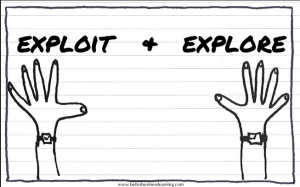
Exploit and ExploreDo we know what are the dependencies and requirements for building and sustaining your organizations innovation success?

How do you sustain innovation, is it more through the structuring of everyday work, by creating a particular set of social rules and resources that foster specific routines? Or something different?

We work really hard at maintaining these re-occurring processes, never willing to extend and push them in different and new ways. We have actually become very static in our approaches and learning, we are not learning anew.

We often simply end up with incremental innovation that might just ‘nudge’ the growth needle but does little more than sustain us in the present and can be ‘contained’ in a tidy process that makes many, including the ‘bean counters,’ very happy until someone changes the game.

Then we need to think differently but this is usually far too late.. As demand is more volatile today we need to experiment, explore, learn and adjust. What becomes more important is the ‘work to be done, and how we go about tackling this and not the work done where we often simply ‘default too. Surprisingly Adam Smith identified this important difference in work way back in 1776.

Read more

We are transcending traditional industry and product boundaries

Global connectionsIt seems this is the era of the digitally savvy entrepreneur.

With the dizzy array of choices, combined with technical prowess and ‘plugging’ these into ‘seen’ customer needs.

These  are setting about disrupting existing businesses and establishing new ones, on an ever-increasing global scale.

So what and how is the incumbent meant to react if it is an existing market?

What should they do when they realize the traditional markets where they have safely operated for years has suddenly been overtaken by a new market creation, one that has gone outside old borders in industry and product.

Markets that are in the hands of the technically savvy entrepreneur are to be sliced, diced and recombined, are providing totally disruptive approaches to existing business models.

If they get the factors right, hit the needs of customers in their design, understanding, agility in responding to learning and adapting, ability to be fast to market and capable of scaling up really fast, then they transform spaces, leaving the established players desperately struggling to find answers and catch up.

The whole world of business is changing radically.

Read more

Achieving Innovations Capability Coherence

Coherence 1Innovation often fails to align to the strategic needs. This is often not the fault of the innovator.

Many innovators are simply happily working away with no specific guidelines, apart from the general remit of “we need to be more innovative”, it lies in the boardroom that is not communicating the board’s needs clearly enough down the organization.

Building up our capacity to innovate does need to understand and reflect the organization’s business activities, as innovators need to grasp the value creation aspects that will deliver the necessary capital-efficient and profitable growth, and then ‘go in pursuit’ to achieve their contribution to these goals.

Even the basic questions often remain unclear, those of how are we looking to grow revenue, save costs, reduce working capital or improve our fixed capital? Managing our innovation activities can help in all of these. Actually if you ask I expect the CFO would say “all of them” but each does have implications on understanding of the fit and eventual role of innovation’s contribution.

Read more

Deeper read or quick summary? Depends on the time we have.

researching_innovationI recently wrote a post “Finding knowledge and research to help you learn and adapt.
On reflection, I should have replaced the word “research” with “time”……time to help you learn and adapt.
Finding time is a real struggle and going that extra mile to read thought leadership views, long often drawn out reports or academic papers can be a step too far, I know but I can’t help myself, it is part of my job and certainly for me, many are really worth the read in a positive end result of new learning.
In that post mentioned above, I was recommending Deloitte and their thought leadership as a good place to visit. Now I’m not sure how many of you actually did so I thought in this blog, to pick out a couple of ‘choice pieces’ and make a posting summary of these, as ones that might be useful.
So I’ve chosen two that challenge and break ground.

Read more

Opening up our innovation to stay relevant

Staying RelevantOur whole understanding of innovation is changing; there are numerous shifts occurring.

We are opening up our thinking about where and with whom, to collaborate.

We are evaluating and changing our existing focus from closed (internal orientation) into one that is having a far more open stance. We are searching for more collaborative innovation (external orientation) combining external partners into more ‘collective thinking’.

The shifts taking place are offering us the promise of “extra acceleration” that is needed to improve our innovation performances from concept to market delivery. Or, we hope it is!

Collaborative innovation is also leading us to higher chances of achieving greater impact and success, as nearly all novel ideas lay are mostly outside the organization’s domain of understanding. We need to always bring the knowledge inside and build from it.

As we increasingly include the customer and their more exacting needs within our understanding, these multiple collaborations and dialogues are building this better internal understanding to align our innovation with specific opportunities, relevancy and needs.

Read more

The New Innovation Value Chain Perhaps?

TSatisfied or Nothese are simply some opening thoughts. For a long time, I have become increasingly dissatisfied with the way we have managed or even depicted the innovation value chain.

I really think we should bring it up to date.

There has been such a considerable change taking place in many of the parts of innovation management, I think we need to replace the existing fuzzy front end, the pipeline and portfolio stage followed by execution with something far more reflective of how we think and what we deploy today as tools, methods and frameworks to deliver innovation.

The ‘old approach’ just does not calibrate anymore for me with where we have been heading, or more importantly in how we are attempting to manage innovation within our organizations.

So I feel we need to determine a new innovation value chain and would like to make the first attempt

Read more

Seeking fresh winds and new directions

the_winds_of_changeAnyone who has felt the ‘full force of the wind’ will know the feeling of how hard it is to keep on your feet, to stay determined to stay upright and true, to hold the course, whatever happens.
When you feel the force of change running through the organization, you tend to have that same sensation, to resist the force with all your energy.
It is often really hard to let go, the environment was something you had become used to, you accepted and become resigned to its weaknesses and constantly exploited its possibilities or even possibly the other way round.

Ignoring the power of choice within change is dangerous

Constructing a climate for any transformation is hard. Our cultures are deep-rooted; we resist those winds blowing into us “full-on,” well beyond being reasonable or smart enough to avoid them before they confront us. The Chinese proverb below gives us a clear choice: “to build walls or build windmills”

Read more

Innovators – are you thinking about Ecosystems?

Business Ecosystem Trends
Business Ecosystem Trends by Deloitte

Thinking about ecosystems certainly allows us to go out of our normal scope of internally generating new products.

It opens up a host of possibilities, that can add significantly to a new service design, new capabilities and solving more complex problems.

In opening up to managing within ecosystems, you begin to see your ability to contribute and tackle societal problems within a collaborative system.

You can see new opportunities that can allow you to enter new markets that would have been impossible as an individual organization.

You begin to see the power, scale and strength of having the collective collaborative ability to extend beyond more traditional thinking design. You go beyond the utilization of leveraging existing infrastructure, building on others’ specializations and leveraging through technology powerful new concepts to tackle increasingly complex innovation design.

Read more