
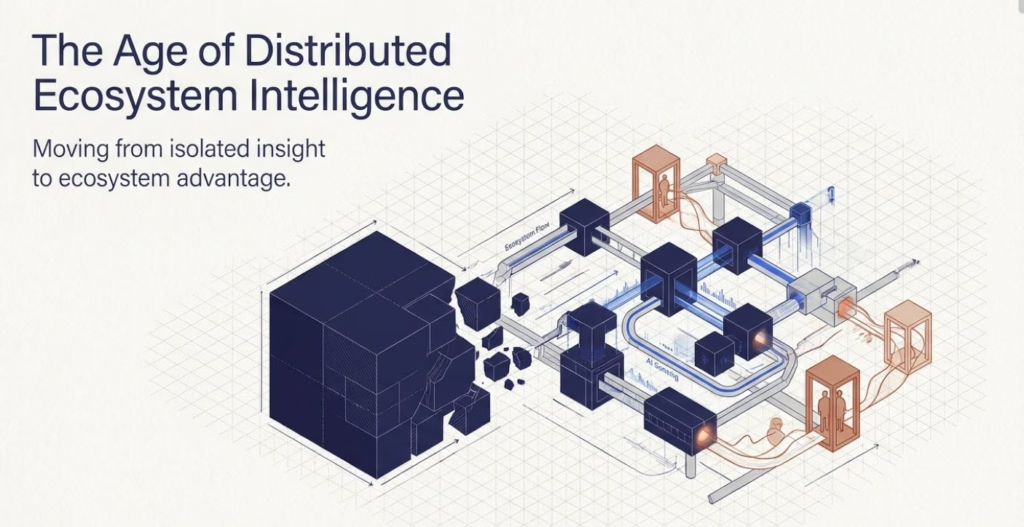
The Age of Distributed Ecosystem Intelligence
I stepped back from this work for a short while. What I came back with is a clearer point to fix my attention on: we are entering the Age of Distributed Ecosystem Intelligence.
Distributed Intelligence is the reality
Ecosystems are the environment
IIBE is the Architecture
Ecosystem Advantage is the Outcome
What has changed
For most of modern business history, intelligence was something an organisation held. It lived in its people, its systems, its data and its processes, and advantage came from holding more of it, or using it better, than competitors.
That picture no longer matches reality. Intelligence now sits across organisations, ecosystems, networks, experts, communities, technologies, data sources, AI systems and agents. Smart grids, connected devices and edge AI make this tangible: sensing happens at the edge, decisions depend on partners who own different assets, and no single organisation sees the whole.
The same is true well beyond energy and industry. In healthcare, agriculture, public services and supply chains, the knowledge that matters is spread across parties who do not report to one another.
Why now
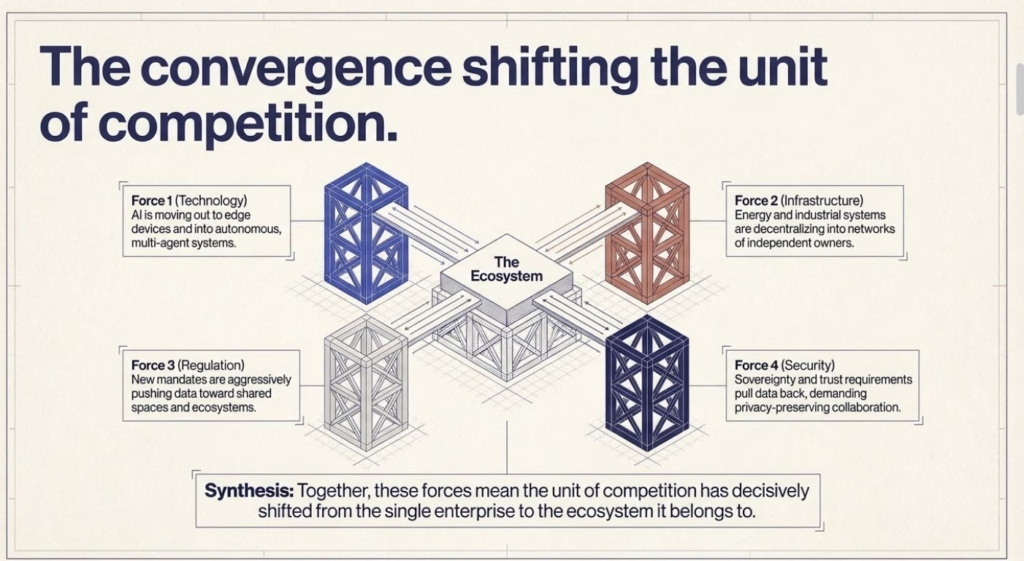
Several things have arrived together. AI is moving out to devices and into autonomous agents. Energy and industrial systems are becoming networks of independent owners. Regulation is pushing data towards sharing, while sovereignty and trust pull the other way. Each of these would be manageable alone. Together they mean that the unit of competition is shifting from the single enterprise towards the ecosystem it belongs to.
Not another AI story
It would be easy to hear this as one more claim about AI. It is not. The technology for sharing intelligence across boundaries is arriving quickly: federated learning, shared data spaces, multi-agent systems, and privacy-preserving ways of working together without surrendering raw data.
What is missing is the architecture for deciding and acting together across independent partners. The constraint is no longer intelligence but coordination across ownership boundaries.
.That is the ground the IIBE and its Triad (human meaning, AI sensing, ecosystem flow) occupy.
The signals are visible if you look for them. Analysts are advising enterprise architects to move from governing decisions to orchestrating ecosystems. Consultations in the energy sector name fragmented governance, and unclear business models and returns, among the main barriers.
Studies of enterprise AI describe pilots that stall and use cases that stay isolated, even as the number of AI agents multiplies. Work on grid operations suggests that real-time AI control is limited more by trust and auditability than by accuracy.
Each points to the same gap. Sharing is becoming possible. Deciding together, fairly and quickly, is not yet designed.
Two recognitions
Two recognitions follow from this.
We need to accelerate. Intelligence is being created faster than any single organisation can absorb it. Waiting for certainty is itself a decision, and an expensive one. Speed is rarely lost where intelligence is created. It is lost at the boundaries, where information waits for approval, partners move at different paces, and nobody holds the authority to act.
We need to cooperate. No enterprise holds enough of the picture on its own. Advantage sits in what independent partners can see together and can decide together, and none of them can see or decide alone.
These can look opposed. Speed seems to demand control, and cooperation seems to demand patience. I think they are one design problem, and that is where the rest of this work lies.
Why “ecosystem” is in the name
“Distributed intelligence” is already used, mostly in engineering, to describe technical architectures for spreading computation across devices. That work matters, but it is not what I am pointing to.
Distributed Ecosystem Intelligence is about independent partners: companies, institutions, communities and machines that do not answer to one centre. What makes it distinct is the need for coordination across them, covering governance, value and decision rights. Who decides, who benefits, who sees what, and how all of it adapts when conditions change.
The unit of competition has been shifting decisively, forces are combining that need orchestration.
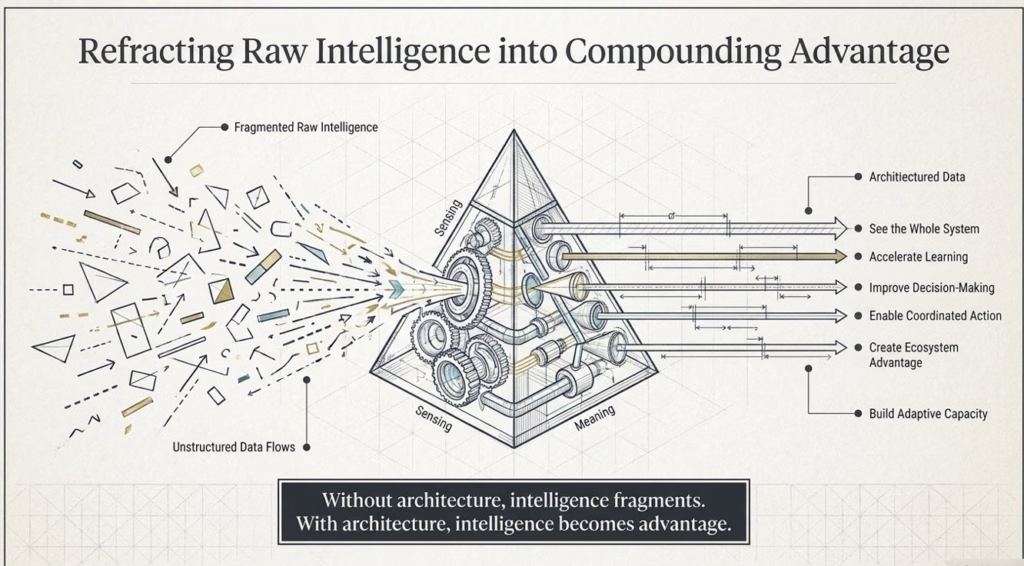
Three things have to work together for this to function: human meaning, AI sensing and ecosystem flow. This is IIBE’s intelligent triad. I will return to each of these parts in later pieces, because AI is only one of the distributed sources, and it is the human and ecosystem parts that are least well understood.
What this asks of leaders
The organisations that prosper in this Age will not necessarily be those with the most data, technology or resources. They will be those most capable of coordinating distributed intelligence and turning it into action.
That asks for three things leaders have not traditionally been asked to design:
- Seeing where intelligence actually sits, including what they already own but have not recognised.
- Connecting it across boundaries without surrendering what makes each partner distinct.
- Converting it into action fast enough to matter in growth, impact and change.
What I will explore here
This site is where I will explore and test this horizon: the thinking, the evidence and the foresight. In the coming weeks I will look at what distributed ecosystem intelligence is and is not, why it matters now, how different sectors are meeting it, and what it asks of those who want to lead. The practical work, where these ideas are put to use in real ecosystems, sits on ecosystems4innovating.com.
Without architecture, intelligence fragments. With architecture, intelligence becomes advantage.
If this horizon matches what you are seeing in your own sector, I would like to hear from you.